
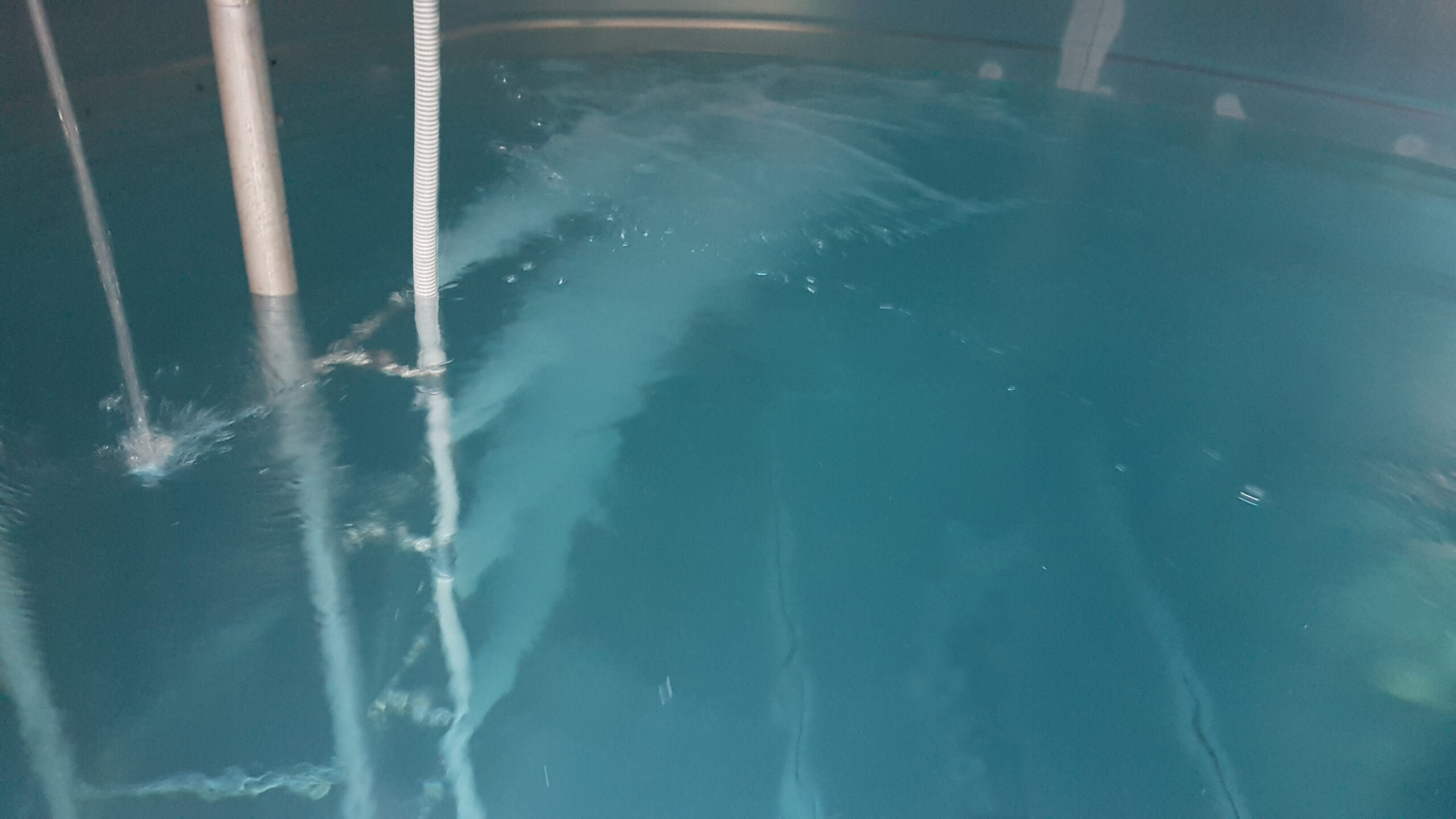
Dead Water Prevention Device
Product Overview
A device installed inside storage tanks (water reservoirs) designed to eliminate dead water (stagnant zones) and improve drinking water quality while preventing contamination.
Key Product Features
- Prevention of Dead Zones and Elimination of Stagnant Water
- Forms a strong vortex flow as water enters, rotating the stored water inside the tank.
- Eliminates blind spots within the tank and prevents the formation of stagnant (dead) water.
- Maintains uniform chlorine concentration, significantly enhancing disinfection efficiency.
- Increase in Dissolved Oxygen
- Mixes air into the incoming water in the form of fine bubbles.
- Enhances the dissolved oxygen levels in the stored water, improving overall water quality.
- Reduction of Residual Radon
- Generates fine air bubbles through a water-air mixing injection system.
- Expands the contact surface between air and radon, enabling effective radon removal.
기존 문제점

01/ Structural Issues
-
Due to the design of the storage tank (reservoir), dead zones (areas of stagnant water) are formed where water circulation is restricted.
-
The placement of the water inlet and outlet creates blind spots with no flow inside the tank. . .
-
Laminar flow reduces water movement, causing the formation of stagnant zones and unstable turbulence within the tank. ..

02/ Reduction of Residual Chlorine in Stored Water
-
As the storage or retention time of water in the tank increases, residual chlorine levels gradually decrease.
-
This leads to a loss of disinfection effectiveness and a higher risk of water quality deterioration.
-
Longer retention times also increase the risk of health threats to usersdue to the formation of disinfection by-products.

03/ Radon Levels Exceeding Standards in Water Supply Facilities
Cases have been reported where radon concentrations exceed acceptable standards in groundwater-based water supply facilities.
Radon, a colorless, odorless, and tasteless Group 1 carcinogen, poses increasing health risks with prolonged exposure.
It is considered a major threat to public health, and urgent countermeasures are required.